Science

Clarity on the floor: differentiating dermal-binding autoantibodies

A newly published international study has demonstrated the high sensitivity of the Euroimmun Dermal Binder Mosaic 1 for detecting antibodies against laminin β4, laminin 332 and collagen type VII. The prospective multicentre study represents the latest milestone in a long-standing research collaboration between Euroimmun and the University of Lübeck, Germany. Shedding light on anti-laminin β4 […]

Science

On the trail of anti-laminin β4 autoantibodies

A collaboration driving discovery A long-standing research collaboration between Euroimmun and the University of Lübeck, Germany has led to major advances in understanding anti-p200 pemphigoid, a rare autoimmune skin blistering disease. Recent publications from the collaborative team have identified laminin subunit beta 4 (laminin β4) as a key autoantigen, demonstrated the pathogenic effects of anti-laminin

Products, Science

New patterns in ANA diagnostics

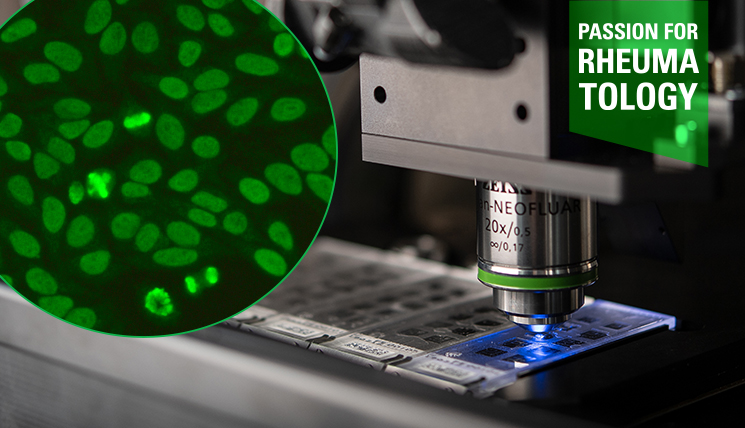
With passion for rheumatology! Recently, three new fluorescence patterns were added to the classification tree of the International Consensus on Antinuclear Antibody Patterns (ICAP)1. ICAP is an initiative of international scientists with the goal of evaluating the large number of ANA patterns in a standardised way. ANA (antinuclear antibodies) are biomarkers for different autoimmune diseases,

Science

Anti-VGLUT2 autoantibodies identified in neurological and multisystem diseases

Vesicular glutamate transporter 2 (VGLUT2) has been identified as a novel target antigen of autoantibodies in patients with neurological disorders, frequently accompanied by comorbidities with cardiovascular and inflammatory involvement. The discovery was made in a collaborative study between Euroimmun and different laboratories and clinics in Germany, which was published recently in the journal Brain, Behavior,

Science

EUROIMMUN Anti-Acetylcholine Receptor ELISA shows high concordance with radioimmunoassay

The EUROIMMUN Anti-Acetylcholine Receptor ELISA shows a high overall concordance with traditional radioimmunoassay (RIA) in patients with myasthenia gravis (MG), while offering advantages such as avoidance of radioisotope waste. This was the conclusion of a study on patients in Japan, which was performed as part of a collaboration between EUROIMMUN and scientists at the Neurology

Scroll to Top